Silent Booth
Bidirectional quiet — outside noise stays out, inside speech stays in.
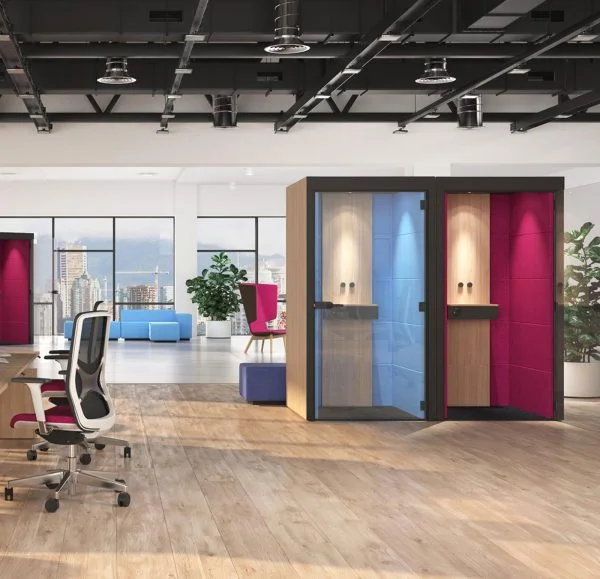
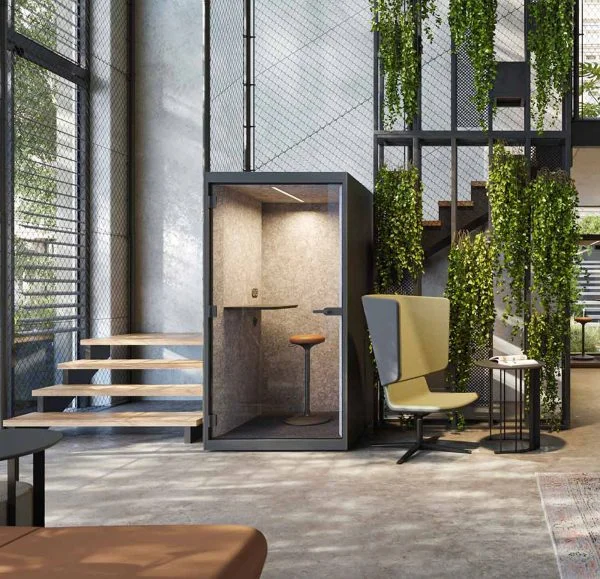
XL Ladin silent cabin — factory-engineered soundproof office pod.
~44 dB speech-band insulation with ISO-referenced test discipline.
105 × 105 × 220 cm single-person footprint for focus and calls.
Ultra-quiet ventilation, 4000 K LED, USB and mains power standard.
Demountable modular build — relocates when your floor plan changes.
Five-year warranty on structure and core components.
Worldwide manufacturing and delivery options.
What Is a Silent Booth?
A silent booth is a self-contained soundproof office pod engineered to deliver controlled quiet on an otherwise noisy open floor. Unlike a partitioned desk or a fabric screen that only softens what you hear locally, a KabinPods silent cabin treats the entire envelope — walls, ceiling, door line, and glass — as one acoustic system. When the door closes, corridor conversation arrives as a distant murmur; when you speak inside, colleagues outside cannot reconstruct your sentences. That bidirectional behaviour is what separates a silent booth from decorative "quiet furniture" that photographs well but fails under real office SPL levels.
We manufacture the XL Ladin silent booth as a demountable module: panels ship flat, pass through standard doorways, and assemble without breaking baseboards or pouring concrete. Footprint is 105 × 105 × 220 cm — a vertical capsule sized for one person with laptop, phone, and notepad. Weight near 240 kg keeps the unit stable freestanding on level floors. When your lease ends or the neighbourhood reorganises, the booth disassembles and reinstalls at the new address. Capital stays with your organisation instead of disappearing into drywall you cannot move.
Silent booths sit inside the broader KabinPods soundproof office pod family. They share factory panel discipline with our meeting and work volumes but optimise for sustained concentration and confidential dialogue rather than team table space. If your floor plan needs a vocabulary for "inside noise stays in, outside noise stays out," the silent cabin is the product name we use for that promise — measured, relocatable, and backed by published insulation references rather than brochure adjectives.
Purpose of a Silent Booth in Modern Workspaces
Modern workplaces traded perimeter offices for transparency and collaboration density. The trade-off is predictable: focus fragments, call quality suffers, and sensitive conversations migrate to stairwells. A silent booth restores a controllable acoustic room without issuing a construction permit. Facilities gain a pod that behaves like a small private office dropped onto the plan — available in seconds, visible through glass so occupancy is obvious, and removable when strategy shifts.
The purpose is not only decibels on a meter; it is behavioural. Employees stop apologising for booking a twelve-seat conference room to take a ten-minute renewal call. Managers conduct performance conversations knowing speech will not carry to adjacent desks. Researchers and analysts enter a volume where keyboard farms and espresso machines no longer compete with thought. Silent booths convert acoustic engineering into daily habit — a door people trust.
For workplace strategists, silent cabins also de-risk hybrid schedules. Hot-desking staff who lack a fixed wall still need a reliable focus anchor. Placing pods within ten seconds of high-call clusters reduces queue time at the door and prevents relapse to open-floor calls that undermine the investment. The booth is infrastructure for attention management in offices that will not return to closed-cell layouts.
How Silent Booths Create a Noise-Free Environment
"Noise-free" in an occupied building means controlled, not absolute zero. A silent booth achieves control through barrier-layer panels that resist sound energy crossing the shell, plus interior absorption that prevents flutter echo from making your own voice sound hollow on video. Cheap pods often excel at absorption alone — the interior feels softer while corridor noise still enters and your speech still leaks. Our cabins combine both: high-density core including Tecsound-class membrane in the stack, laminated tempered glass, magnetic door closure, and perimeter gaskets tuned with the same discipline as the wall panels.
Weak points determine field performance more than average panel thickness. A gap at the threshold or a thin non-laminated door leaf can collapse an otherwise strong lab score. Installation crews verify gasket seating at handover because insulation lives in millimetres. In speech frequencies we target roughly 44 dB under laboratory conditions referenced to ISO 140-3 and ISO 717-1; on busy open floors measuring 65–75 dB, occupants commonly experience 35–40 dB inside when door discipline and placement are correct.
Ventilation is part of the quiet equation. Stale, stuffy boxes encourage propped doors — which destroys the insulation line. Ultra-quiet fans below 16 dB perceived hum exchange air during occupancy without adding the whine that makes users leave the door ajar. Integrated 4000 K LED at 150+ lux keeps faces video-ready so users are not tempted to relocate calls because the interior feels cave-like. Noise-free, in practice, is a system: shell, seal, air, and light working together.
Key Differences Between Silent Cabin and Phone Booth
Both are compact pods for open offices and often share similar footprints. The difference is positioning and acoustic emphasis. A phone booth is language for call-first, drop-in workflows — stand or sit, finish the line, return to the desk. A silent cabin names the bidirectional quiet promise: long video sessions, deep focus blocks, and dialogues where inside energy must not become corridor content. Phone booths answer "where do I take this call?" Silent cabins answer "where can I think and speak without the floor participating?"
Technically, KabinPods applies the same factory ethics across both lines — barrier panels, sealed glass, modular relocation. Marketing language differs because buyers search by problem. If your procurement brief prioritises measurable two-way privacy and sustained concentration, specify silent booth. If the primary pain is queue time for short outbound calls, compare our phone booth and phone call booth lines with identical footprint discipline but call-first positioning.
Capacity is the second axis. This page describes the single-person XL Ladin silent booth. When quiet must scale to paired reviews or small team syncs, our meeting pod adds table depth and air volume without leaving the open floor. For half-day focus without call interruption, see the work pod line — same insulation philosophy, longer-stay ergonomics.
Benefits of Silent Booths
Silent booths translate acoustic specification into outcomes facilities can defend in budget meetings: fewer repeated phrases on calls, less meeting-room hoarding for solo conversations, and lower noise complaints on employee surveys. The benefits below are what we hear from deployments across finance, legal, technology, healthcare administration, and coworking — not generic open-office slogans.
Deep Focus Work Without Distractions
Deep work requires more than headphones. ANC reduces what reaches your ears but does not stop neighbours from hearing you mutter through a complex model, and it does not remove the cognitive load of intermittent speech you still parse in peripheral awareness. Inside a silent cabin, external speech arrives attenuated below the threshold that triggers orienting reflex — you stop tracking who said what three desks away.
Interior NRC between 0.90 and 1.00 controls flutter echo so your own voice stays clear without the dead, muffled tone that makes long writing sessions uncomfortable. Analysts, designers, and engineers report longer uninterrupted blocks once a trusted pod sits near their cluster — not because magic happened, but because the sensory boundary is physical and repeatable.
Private Space for Calls and Meetings
Confidentiality is procedural and physical. Policy training helps; a shell that keeps speech unintelligible outside completes the loop. Silent booths host client renewals, insurer authorisations, HR conversations, and vendor security reviews without constructing fixed rooms. Glass maintains visual contact with the floor so managers see occupancy; laminated build and gaskets maintain acoustic separation.
For video, the remote party hears you — not the trading row. Microphones capture direct voice because reverberation is controlled and background SPL is reduced. That is the difference between a professional call and apologising for office noise on every third sentence.
Improved Productivity in Open Offices
Productivity gains show up as reclaimed calendar and fewer context switches. Before pods, ten-minute calls consumed twenty-five minutes with room booking, walking, and settling. Silent booths adjacent to desks shrink that overhead to seconds — door, sit, speak, return. Meeting rooms free for actual meetings; solo conversations stop displacing team sessions.
Noise complaint tickets fall when high-call roles have a sanctioned outlet. Facilities measure success in queue time at the door: persistent waits mean add units before users revert to open-floor behaviour and the investment stalls. We size counts from measured call traffic, not generic one-per-floor rules.
Flexible and Modular Office Solution
Fixed drywall quiet rooms lock capital to a single address. Silent cabins demount, ship internationally, and reinstall after reorganisation or lease relocation. That flexibility matters for growing firms, portfolio rollouts, and coworking operators who reconfigure monthly. Panels pass through elevators and standard doorways; assembly averages 2–3 hours on a level floor with power only — no anchors required on level surfaces.
Modularity also de-risks pilot programmes. Start with one or two pods, measure utilisation and survey outcomes, then expand the bank without tearing down construction. The same specification replicates across regions so acoustic performance stays consistent from headquarters to branch.
Pods · Meeting
Meeting Pod
When silent work scales to paired reviews or small team syncs, our meeting pod adds table space without leaving the open floor.
Explore Meeting Pod.webp)
Silent Cabin Features
Every feature below is specified as part of the insulation system — not a checklist of aftermarket accessories. Silent cabins ship ready for daily use: power, air, light, and interior ergonomics integrated at the factory so site work stays assembly, not electrical fit-out.
High Acoustic Performance Insulation
Multi-layer body panels combine structural faces, dense barrier membrane, and interior PET felt absorption. Door line uses laminated tempered safety glass with magnetic closure and homogenous gasket contact around the full perimeter. Speech-band insulation targets ~44 dB in lab conditions; field results on occupied floors often land in the 46–50 dB band when placement and door discipline are correct.
Certificates include ISO 140-3, ISO 717-1, ISO 10534-2:2023, and ISO 11957 — insulation claims reference tests, not adjectives. Quarterly gasket inspection and keeping the door fully closed during use preserve performance across years of daily cycles.
Advanced Air Ventilation System
Ultra-quiet fans exchange air during occupancy at perceived levels below 16 dB — users do not hear a drone that forces the door open. Dual-path ventilation maintains fresh air for sessions exceeding thirty minutes without stuffiness or CO₂ build-up that makes focus pods feel punitive. Grilles are reachable for filter cleaning; facilities receive maintenance guidance at handover.
Integrated LED Lighting System
4000 K integrated LED delivers 150+ lux at working height — neutral colour for screen reading and video calls without orange cast or glare spots. Lighting is switched with occupancy logic so users are not hunting wall panels in a dim box. Face illumination reads professional on camera without supplemental desk lamps crowding the compact interior.
Power Outlets and USB Charging Ports
Grounded 220 V AC, USB-A, and USB-C are standard inside the shell; cabling routes through the panel build so the interior stays tidy. Laptop, phone, headset base, and occasional monitor setups are supported without extension cords across the doorway — which would compromise seals. Wireless charging is available on request for corporate fit-out programmes.
Minimalist and Ergonomic Interior Design
Compact footprint demands disciplined ergonomics: comfortable seating, laptop shelf at appropriate height, and clear door swing for entry with bag. Fabric-wrapped acoustic walls reduce visual noise; anti-static carpet tiles add underfoot comfort and impact absorption. The interior reads as modern office furniture — not telecom equipment — so employees enter willingly instead of avoiding the "box in the corner."
Types of Silent Cabins
KabinPods silent cabins scale from single-person capsules through custom modular runs. The types below map to how buyers plan floor capacity — start from behaviour (solo focus vs paired review vs team session), then match interior volume and insulation specification.
Single Person Silent Cabins
The XL Ladin silent booth on this page is the single-person standard: 105 × 105 × 220 cm, ~240 kg, one occupant with laptop and phone. It serves high-frequency callers, analysts needing deep blocks, and any role where bidirectional quiet must sit within ten seconds of the desk cluster. This is the highest-utilisation type in most deployments — size the bank from measured solo call and focus traffic first.
Two Person Silent Cabins
When two people must hear each other clearly without the open floor listening — coaching, paired code review, dual-party client lines — interior width and ceiling volume increase while preserving the same panel and gasket discipline. Two-person silent cabins trade a slightly larger footprint for shared quiet without booking a full conference room. Quote from site dimensions and daily paired-session counts.
Meeting Size Silent Cabins
Four- to six-person silent volumes support stand-ups, interview panels, and workshop segments that need table space plus insulation. These are soundproof office pods in the true sense — team scale with barrier-layer build rather than felt-lined meeting boxes. Explore our acoustic booth range for capacity tiers with published acoustic targets across the family.
Custom Modular Silent Cabin Solutions
Tandem capsule banks, corner wraps, and branded wall runs are manufactured to order from plans and usage data. Custom modular silent cabins let headquarters identity roll out to regional floors without re-engineering each address. We model door swing, fire routes, and walkway clearance before production so installation does not block circulation.
Where Are Silent Cabins Used?
Silent cabins deploy anywhere open plans create focus and privacy friction without budget for permanent build-out. The sectors below are representative — the common thread is bidirectional quiet as operational requirement, not amenity nicety.
Corporate Offices
Headquarters and regional floors place silent booths at open-plan perimeters, cluster ends, and corridor niches. Finance, legal, HR, and executive support use them for conversations that cannot float across desks. Technology firms pair pods with bench seating so incident bridges and security reviews have a controlled volume. Placement within ten seconds of high-call neighbourhoods drives adoption; hiding pods on distant floors guarantees underutilisation.
Coworking Spaces
Operators monetise silent cabins as premium hourly amenities — the feature that stops members taking client calls in stairwells. Glass visibility supports fair queueing; bidirectional insulation supports professional pitch quality. Multiple single-person units often outperform one large room because solo calls dominate traffic.
Libraries and Study Areas
Universities and public libraries add silent booths for interview practice, virtual thesis defences, and confidential advising without semester-long construction. Occupants experience library-quiet inside while group study continues outside the shell — a compromise fixed rooms rarely offer mid-semester.
Call Centers and Remote Work Hubs
Live floors need pods for escalation handling, quality monitoring, and supervisor coaching beside eighty active stations. Silent cabins keep coaching content between coach and agent. Hybrid hubs hot-desking three days weekly use pods as the consistent focus asset remote staff lack at home — reducing ANC fatigue from all-day headphone use.
Healthcare and Quiet Zones
Hospital administration, clinic back offices, and insurer coordination desks handle PHI daily. Silent booths support scheduling and authorisation calls in open admin wings where new drywall is impractical mid-operation. Easy-clean interiors and replaceable carpet tiles align with facility protocols; measured insulation supports privacy programmes alongside policy controls.
Pods · Work
Work Pod
Half-day focus without call interruption needs more air volume and desk depth — our work pod extends silent-cabin engineering for longer stays.
Explore Work Pod
Custom Silent Cabin Solutions
Standard XL Ladin silent booths cover most solo-call and focus demand. Custom programmes align size, finishes, and branding with architectural standards and corporate identity — every unit made to order, not anonymous stock grey boxes dropped on the plan.
Size and Layout Customization
Non-standard widths, tandem banks, and L-shaped wraps are quoted from measured site dimensions and traffic data — daily call count, average duration, peak overlap windows. We model ergonomic clearances and maintenance access before fabrication so pods do not obstruct fire routes or pinch circulation paths after installation.
Glass, Frame and Door Options
Laminated tempered safety glass is standard; opacity bands, tint levels, and hinge orientation are confirmed against plans. Thinner non-laminated swaps compromise insulation targets — we maintain laminated build across configurations. Closing speed and latch feel are tuned to reduce door slamming that stresses seals over thousands of cycles.
Interior Material and Color Selection
Interior fabric spans neutrals, warm beiges, and brand-matched accents; structural faces use melamine-coated MDF where durability matters. Exterior melamine and aluminium trim coordinate with lobby and workstation palettes. Two-tone schemes — darker outside, lighter inside — are common in glass-heavy architecture. Finish samples are issued under your floor lighting before batch production.
Branding and Corporate Identity Integration
Logo panels, custom powder-coat trims, and interior accent colours carry headquarters identity to regional rollouts. Facilities and design teams approve texture and colour once for every site in the programme — acoustic specification replicates without renegotiating performance at each address.
Why Choose KabinPods Silent Cabins?
KabinPods manufactures silent booths as engineered systems — panels, glass, gaskets, ventilation, and interior absorption specified together, measured against published standards, and backed by a five-year warranty. We ship internationally from the same production line that builds our wider soundproof office pod family so performance stays consistent site to site.
Superior Acoustic Engineering
~44 dB speech-band insulation target, interior NRC up to 1.00, two-way privacy on open floors. Weak-point discipline on door, glass, and floor seal separates field results from lab brochures. Install crews verify gasket continuity at handover; maintenance guidance preserves performance across years.
Modern Architectural Design
Framed glass, fabric interiors, and flush integrated services read as office furniture — compact vertical proportion avoids the bulky cabinet look that makes employees resist entry. Clients and candidates notice the difference on workplace tours; pods signal that concentration is sanctioned infrastructure, not a workaround.
Durable and Long-Lasting Materials
Melamine structure, aluminium framing, serviceable hinges and fans, replaceable carpet tiles — chosen for ten-year office life, not three-year refresh cycles. ISO 14001 environmental management supports corporate sustainability reporting alongside acoustic documentation.
Global Delivery and Installation Support
Demounted international shipping with KabinPods or partner assembly. Written quotes for freight, customs, and labour on overseas projects. Spare parts, filter cleaning guidance, and relocation documentation help facilities own lifecycle after handover — same silent cabin specification replicated across regional rollouts without re-engineering each building. For insulation-first single occupancy with published dB targets, compare our soundproof booth line; for the full pod portfolio overview, visit office pods.
Watch KabinPods products in action

CUSTOMER REVIEWS
What Customers Say About Silent Booth
SILENT BOOTH FAQ
Frequently Asked Questions About Silent Booths
What workplace and facilities teams ask before adding soundproof office pods for focus and confidential calls.
A silent booth is a freestanding, factory-built enclosure that controls sound in both directions — outside noise stays out and inside speech stays in. A quiet corner with partitions or headsets reduces distraction but does not stop conversation from crossing the open floor. KabinPods silent booths are engineered shells with barrier panels, sealed glass, and measured insulation targets.
You May Also Like
.webp)
Proudly Manufactured in Turkey
Every KabinPods unit is built in our own factory to high quality standards. We ship worldwide without compromising on materials or workmanship.
11 Years of Experience
Our specialist team has supported corporate clients for more than eleven years with reliable delivery and professional project support at every stage.
Fast, Secure Shipping
Flexible delivery options and dependable logistics get your acoustic booths to site on schedule — across Europe, the Middle East, and international projects.