Office Pod
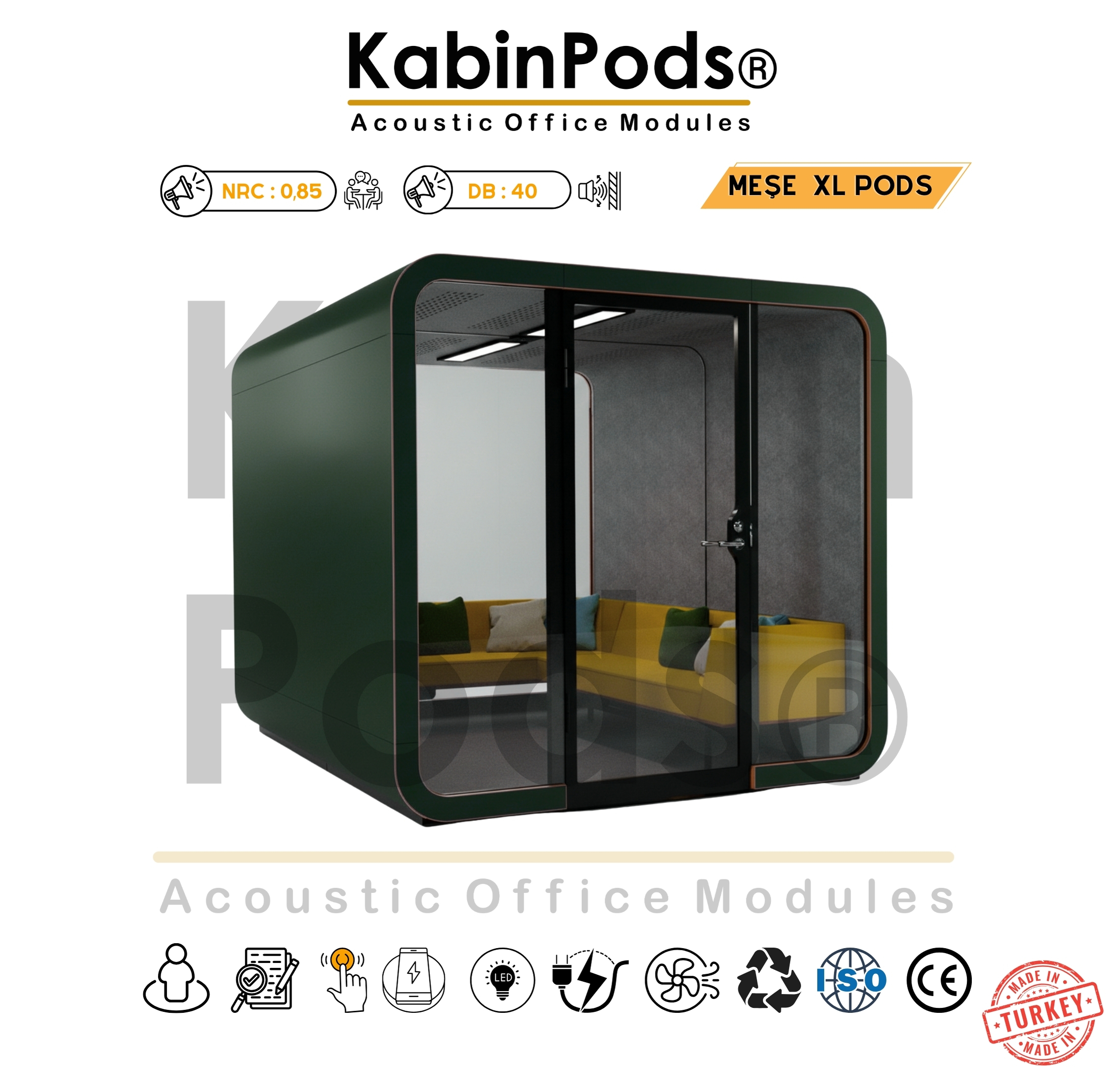
XL Acoustic Office Cabin — enclosed private volume on the open floor.
~35 dB Rw, ~90% sound insulation across barrier-layer envelope.
220 × 130 × 225 cm exterior — desk-depth interior for extended work.
4000 K LED, six air changes/hour ventilation, dual USB and mains power.
Modular demountable build — relocates when your office moves.
Ten-year corporate warranty on structure and core components.
Factory-direct from KabinPods — global delivery and installation support.
What Is an Office Pod?
An office pod is a freestanding, factory-built acoustic enclosure that creates a private work room on an open floor without touching the building shell. It is not a phone capsule sized for three-minute calls, and it is not a permanent stud-wall room that disappears when the lease ends. KabinPods office pods, including the XL Acoustic Office Cabin on this page, ship as demounted panels, assemble on site in hours, and deliver enclosed volume with integrated ventilation, lighting, power, and published sound insulation targets. When the door closes, the open office becomes background noise. Inside, you gain desk depth, visual calm, and acoustic control suitable for hours of focus, not just a quick dial-out. Buyers searching for soundproof office pods often compare decorative partitions first; the difference is that a real office pod treats walls, ceiling, door line, and glass as one insulation system rather than a visual screen that leaves speech and corridor noise unchanged.
The category sits between compact call booths and full meeting rooms. Phone booths optimise for single-person call-first workflows in minimal footprint. Meeting pods add table space for two-to-four person syncs. Office pods emphasise enclosed individual work and flexible private volume for hybrid employees who need a reliable focus anchor, managers who need confidential dialogue without booking architecture, and teams that need temporary private zones without construction lead times. Our XL model measures 220 cm wide by 130 cm deep by 225 cm high externally, with roughly 200 cm by 110 cm by 205 cm usable interior. That footprint supports seated desk work, video calls, and short paired discussions when configured with appropriate seating. If your floor plan already lists phone booths but employees still book conference rooms for solo spreadsheet work, the gap is usually interior depth and stay time, not another call capsule.
Modularity defines the lifecycle. Panels pass through standard doorways and elevators. Weight near 500 kg stabilises the unit freestanding on level floors. When headquarters relocates or the neighbourhood reorganises, the pod disassembles and reinstalls at the new address. Growing firms and portfolio rollouts choose factory office pods over drywall that cannot move because acoustic capital stays with the organisation instead of being written off as tenant improvement. For international rollouts, the same panel specification replicates across sites so procurement does not renegotiate performance city by city.
How Office Pods Transform Modern Workspaces
Open plans promised collaboration but delivered chronic friction: focus fragmentation, meeting-room hoarding for solo calls, and hybrid staff without a fixed wall. Office pods reintroduce controlled privacy as furniture, visible through glass, adopted by habit, and removable by design. Facilities place pods within ten seconds of high-focus clusters so adoption is walking distance, not a floor away. Employees stop treating concentration as something that requires calendar negotiation. Workplace strategists also gain a visible signal that deep work is allowed on the same floor where collaboration is encouraged, which reduces the guilt employees feel when they need quiet during core hours.
Transformation shows up in operational metrics, not only comfort surveys. Teams report fewer repeated phrases on video calls, lower bookings of twelve-seat rooms for ten-minute conversations, and reduced noise complaints on workplace surveys. Pods signal that deep work and confidential dialogue are sanctioned infrastructure, not something you apologise for. Workplace tours improve when candidates see engineered quiet instead of headphones worn all day as a badge of endurance. Facilities teams also see fewer ad hoc requests to build stud walls when headcount shifts, because pods absorb reorganisation without change orders.
For hybrid programmes, office pods become the consistent anchor hot-deskers lack at home. Three days on-site without an assigned desk still includes a pod queue everyone understands: private volume without claiming perimeter offices that leadership needs. That fairness matters as much as decibels on a meter. Remote managers notice when in-office days sound professional on calls, and hybrid equity improves when the office provides conditions comparable to a well set up home workspace.
Difference Between Office Pod and Meeting Pod
Both are soundproof office pods in the KabinPods family. The difference is primary use and interior geometry. Meeting pods optimise for table-centred sessions: sprint syncs, client calls with two attendees, HR interviews with panel seating. Interior air volume and table depth assume multiple people facing each other. Office pods optimise for enclosed work: one person with laptop for extended blocks, video calls with desk ergonomics, and flexible private volume that can host a short paired discussion without daily four-person calendar demand. If your team books four-person pods but half the sessions are one person on a laptop, you are paying for air volume you do not use.
Acoustic specification overlaps through barrier panels, laminated glass, and gasketed doors, but footprint and ergonomics diverge. If daily behaviour is mostly team table sessions, start with our meeting pod. If the bottleneck is individual focus, hybrid concentration, and confidential one-to-one dialogue in enclosed volume, the office pod is the correct category. Many floors deploy both: meeting pods for collaboration peaks, office pods for focus and privacy baselines. Pairing the two reduces overbooking on either type and keeps queue times honest at the door.
Why Companies Are Moving to Office Pods
Construction timelines and lease uncertainty make fixed quiet rooms risky. Office pods install in days, relocate in weeks, and scale by adding units instead of issuing change orders. Procurement likes published insulation references instead of contractor promises. HR and compliance like physical privacy layers alongside policy. Sustainability reporting likes modular assets that move rather than drywall demolished every relocation. In competitive labour markets, office pod programmes also appear on employer brand materials because candidates associate them with a workplace that respects focus, not only open collaboration.
Real-estate strategy shifted from seats per square metre to outcomes per square metre. One office pod often replaces multiple daily meeting-room bookings for solo work, freeing conference inventory for actual conferences. The pod is capital expenditure that behaves like flexible infrastructure. Portfolio companies standardise pod specifications across regions so facilities playbooks stay simple: same maintenance routine, same spare parts list, same acoustic expectation on every floor.
Why Office Pods Are Needed Today
The open office is not reversing globally. The response is smarter acoustic furniture, not a return to cellular plans everywhere. The sections below name the frictions office pods address on live floors: daily operational cost, not theoretical annoyance. Search demand for office pod solutions rose because occupancy density increased faster than perimeter office stock, and hybrid video load turned every desk into a potential broadcast point.
Problems in Open-Plan Offices
Density increased while perimeter offices disappeared. Keyboard farms, espresso machines, standing conversations, and phone culture stack into continuous 65 to 75 dB backgrounds that make complex work expensive. Collaboration zones bleed into focus zones because the plan lacks physical boundaries. Meeting rooms become escape valves booked for solo spreadsheet work because nothing else exists. Office pods add boundaries without walls. They also reduce the informal negotiation where employees ask neighbours to keep voices down, which erodes team rapport over time.
Activity-based working promised choice but often delivered anxiety about finding quiet. Office pods make quiet locatable: glass shows occupancy, placement near clusters keeps walk time low, and facilities can count utilisation instead of guessing from complaint tickets. That locatability matters when leadership asks for evidence before approving the next pod purchase.
Lack of Privacy and Focus Issues
Privacy is procedural and sensory. Employees cannot discuss performance, compensation, or client risk at desks without neighbours parsing tone. Focus breaks when the brain tracks every nearby sentence even when headphones are on. Headphones reduce incoming noise but do not stop outgoing speech or eliminate cognitive load from partial speech intelligibility. Office pods deliver enclosed volume where both directions are controlled, not whispering that depends on everyone cooperating.
Regulated sectors need more than policy PDFs. Banking, insurance, legal, and healthcare administration benefit when speech is physically unintelligible outside the enclosure. Office pods provide that layer without waiting for a build permit. Training and signage still matter, but the shell completes the loop employees and auditors expect to see on site walks.
Increasing Hybrid Work Demands
Hybrid schedules mean fewer assigned desks and more camera-on calls from the office. Employees need predictable quiet for remote teammates who hear everything the laptop microphone captures. Office pods standardise call quality and focus conditions for in-office hybrid days. They reduce the habit of taking client calls from cars or cafés because the open floor failed. Facilities can also schedule pod maintenance in off-peak windows without closing a whole meeting room wing.
Hot-desking without quiet infrastructure pushes cost to individuals in the form of fatigue and repeat explanations on calls. Office pods socialise that cost back to the workplace design where it belongs. Teams with three in-office days per week often see the highest pod utilisation because the pod becomes the one fixed anchor in an otherwise fluid desk map.
Office Pod Use Cases
Office pods serve any sector where open plans meet focus, confidentiality, and call-quality requirements without budget for permanent build-out. The scenarios below are the highest-frequency deployments we support internationally. When you map your own floor, start from behaviours that already happen in corridors and stairwells; those are the workflows pods should absorb first.
Individual Focus Workstations
Developers, analysts, writers, and designers use office pods for two-to-four hour deep blocks, work that collapses when interrupted every ninety seconds. Desk-depth interior supports laptop, external monitor on request, and notepad without the claustrophobia of phone-scale capsules. Ventilation and lighting are tuned for sessions longer than a single call. Teams running agile sprints often reserve pods for individual story work between stand-ups so the open floor stays available for quick collaboration without sacrificing flow state.
Short Meetings and Quick Discussions
Not every conversation needs a four-person meeting pod. Two colleagues reviewing a contract clause, a manager giving ten-minute feedback, or a recruiter conducting a phone screen fit office pod volume without consuming team table inventory. Door closed, glass visible, queue fair: pods prevent informal meetings from happening at desks where everyone listens. That shift alone can lower noise complaints faster than another round of desk signage.
Video Calls and Remote Work Sessions
Remote participants judge professionalism from audio quality. Office pods reduce background sound level so microphones capture direct voice. Interior absorption controls flutter echo so you do not sound distant or hollow. Sales, support, and executive staff take external calls without apologising for office noise. Hybrid equity improves when in-office days sound as clean as home offices with proper setup. For customer-facing roles, cleaner audio often means shorter calls and higher close rates because objections are not drowned by ambient chatter.
Temporary Private Work Zones
Project war rooms, audit periods, and onboarding cohorts need temporary privacy without construction. Office pods deploy for quarter-long programmes and relocate when the project ends, or stay as permanent focus infrastructure if utilisation justifies the footprint. Coworking operators use the same flexibility for premium hourly zones that members book alongside open desks. Corporate real estate teams use pods during floor refreshes when permanent quiet rooms are offline but work cannot pause.
Pods · Meeting
Meeting Pod
When daily behaviour centres on table-centred team syncs, our meeting pod adds capacity without leaving the open floor.
Explore Meeting Pod.webp)
Office Pod Design and Structure
KabinPods office pods are engineered systems where shell, glass, gaskets, interior absorption, ventilation, and services are specified together. The XL Acoustic Office Cabin on this page reflects that discipline in a single-person enclosed volume with commercial-grade durability. Weak-point control at the door line matters as much as average panel thickness, because a single air gap can undo brochure claims on busy floors.
Compact Modular Architecture
Panels ship demounted. Assembly on level floors averages a few hours with professional crews. No floor anchors are required on level surfaces, and no breaking baseboards or pouring concrete is needed. Aluminium-framed melamine structure resists daily contact in corridor-adjacent placements. When layout changes, pods move, so capital is not trapped in fixed rooms. Demounted shipping also helps international projects where crane access or tight lifts would block monolithic units.
Sound Isolation Technology
Multi-layer body construction combines structural faces, high-density acoustic core, and interior absorption panels. Target performance is approximately 35 dB Rw with roughly 90 percent sound insulation across the envelope. Speech from inside does not reconstruct as intelligible sentences outside at normal distance, and corridor noise enters attenuated. The door line uses tempered laminated glass, magnetic closure, and perimeter gaskets because weak points collapse field results faster than thin walls help in marketing copy. Install crews verify gasket seating at handover because insulation performance lives in millimetres, not adjectives.
Integrated Ventilation System
Ventilation targets six air changes per hour at low perceived noise, delivering fresh air for multi-hour occupancy without the stuffiness that makes users prop doors open. Propped doors destroy the insulation line and are a common reason pods underperform after launch. Filter access and maintenance guidance are part of handover so facilities teams own lifecycle after installation. Quarterly grille cleaning and annual filter replacement are typical routines on high-utilisation floors.
Lighting and Power Solutions
Integrated 4000 K LED at approximately 500 lumens supports screen work and video without supplemental desk lamps crowding the interior. Two grounded outlets and two USB ports are factory-integrated, with cabling routed through the panel build so users are not draping extension cords across the doorway. Anti-static carpet tiles add underfoot comfort and impact absorption. Power layout is confirmed against your local electrical standards before export shipments leave the factory.
Types of Office Pods
KabinPods manufactures office pods from single-person enclosed volumes through custom modular runs. Capacity and interior depth should match measured behaviour, not generic one-size charts copied from a competitor brochure. A short utilisation study before purchase usually pays for itself in avoided overbuilding.
Single Person Office Pods
The XL Acoustic Office Cabin is our single-person office pod standard: desk-depth interior, near 500 kg stabilised shell, and insulation specification suited to extended focus and confidential calls. Size the bank from solo focus hours and daily video-call counts per neighbourhood. One pod per twenty-five to thirty heavy users is a common starting ratio on finance and technology floors, then adjust after two weeks of door-queue observation.
Double User Office Pods
When paired reviews, coaching, or dual-party client lines happen daily, wider interior modules accommodate two seated participants while preserving gasket and glass discipline. Quote from site dimensions and peak overlap windows. We model door swing and circulation before production so installation does not block fire routes or pinch walkway clearance. Double-user office pods are popular beside trading and operations clusters where coaching happens hourly.
Flexible Multi-Purpose Pods
Some programmes need pods that serve focus mornings and small discussions afternoons. Interior layout and seating flexibility matter as much as raw insulation. Custom modular office pods align footprint with your floor plate. Tandem banks and corner wraps integrate with brand environments visible on workplace tours. Multi-purpose configurations are common in headquarters lobbies where the same unit must look architectural by day and stay acoustic by night.
Benefits of Office Pods for Businesses
Benefits compound when pods sit near the teams that need them and when utilisation is tracked honestly. The outcomes below are what facilities report after ninety days, not launch-day enthusiasm. Tracking door cycles and peak queue time gives procurement hard data for the next expansion batch.
Increased Employee Efficiency
Reclaimed calendar time and fewer context switches translate to more completed focus blocks and cleaner calls. Employees spend less time walking to distant quiet space or repeating information because microphones captured floor noise. Efficiency is measured in hours returned to productive work, not motivational posters. Teams that log focus time often see pod sessions cluster before deadlines, which is a signal the asset is doing real work rather than serving as unused furniture.
Better Use of Office Space
One office pod often absorbs dozens of weekly solo meetings that previously consumed conference rooms sized for teams. Real estate teams redeploy conference inventory or reduce square metres dedicated to fixed quiet rooms that sit empty between bookings. Pods turn dead corners into productive volume without increasing rentable area. That matters when lease costs rise but headcount plans stay flat.
Reduced Noise Complaints
Noise tickets fall when high-call and high-focus roles have sanctioned outlets. Neighbours stop policing informal desk calls because pods absorb the behaviour. Surveys improve when concentration is infrastructure, not individual endurance. Facilities can point to pods in response to recurring complaints instead of issuing another quiet-hour policy that collaboration culture ignores by afternoon.
Flexible Workplace Scaling
Add pods in pilots, measure queue time, expand banks without construction. Relocate units when floors reorganise. Replicate specification across regions without re-engineering each address. Flexible scaling beats one-time drywall that cannot follow headcount. When a business unit shrinks, pods move to the growing site instead of becoming stranded build-out sunk cost.
Custom Office Pod Solutions
Standard XL models cover most enclosed-work demand. Custom programmes align size, finishes, and branding with architectural standards. Every unit is made to order, not anonymous stock boxes dropped on the plan without site measurement. Custom does not have to mean slow: lead times are quoted against your finish package and shipment lane up front.
Size and Layout Customization
Non-standard widths, tandem pod banks, and L-shaped wraps are quoted from measured dimensions and traffic data. We model ergonomic clearances, maintenance access, and fire routes before fabrication so installation does not pinch circulation. Corner placements are popular in legacy floor plates where rectangular pods would block sightlines supervisors rely on.
Interior Comfort Options
Seating grade, worksurface depth, monitor mounting, and interior fabric palettes are confirmed against usage. Extended focus needs different ergonomics than call-only capsules. Finish samples are reviewed under your floor lighting before batch production so colour and texture approvals happen once for every site in a rollout.
Glass and Privacy Levels
Laminated safety glass is standard. Opacity bands, tint levels, and hinge orientation align with visibility policies. Some programmes maximise glass for occupancy signalling. Others add partial opacity for sensitive conversations while keeping insulation targets across configurations. Hinge side is confirmed against corridor width so door swing never blocks egress paths.
Branding Integration
Logo panels, custom powder-coat trims, and interior accent colours carry headquarters identity to regional rollouts. Facilities and design teams approve once for every site in the programme. Acoustic specification replicates without renegotiating performance at each building. Brand integration is especially common in customer-facing floors where pods sit in sightlines from reception.
Pods · Work
Work Pod
When enclosed volume must scale to half-day team focus or larger headcount, our work pod extends the same engineering approach.
Explore Work Pod
Why Choose KabinPods Office Pods?
KabinPods manufactures soundproof office pods as complete systems: measured insulation, modular relocation, integrated services, and ten-year corporate warranty on the XL Acoustic Office Cabin line. We ship internationally from unified production so performance stays consistent site to site. You deal with one manufacturer for panels, glass, fans, and gaskets instead of stitching together incompatible subsystems from multiple vendors.
Engineering-Focused Acoustic Design
Approximately 35 dB Rw and near 90 percent insulation targets, gasket discipline on door and glass lines, and interior absorption for video-ready clarity. Certificates include ISO 140-3, ISO 717-1, ISO 10534-2:2023, and ISO 11957. Claims reference tests, not brochure adjectives. Install crews verify seal continuity at handover, and we document maintenance routines that keep performance stable across years of daily door cycles.
Durable Commercial Materials
Melamine structure, aluminium framing, serviceable hinges and fans, and replaceable carpet tiles are specified for ten-year office life. ISO 14001 environmental management supports corporate sustainability reporting alongside acoustic documentation. Hinges and fans are chosen for service access because high-utilisation pods see thousands of cycles per year on active floors.
Modern Office Aesthetics
Framed glass, fabric interiors, and flush integrated services read as office furniture. Compact vertical proportion avoids telecom-cabinet stigma that makes employees resist entry. Clients and candidates notice on tours when quiet work is designed in, not bolted on as an afterthought in a noisy corner.
Global Delivery and Installation Support
Demounted international shipping with KabinPods or partner assembly. Written quotes for freight, customs, and labour on overseas projects. Spare parts, maintenance guidance, and relocation documentation help facilities own lifecycle after handover. For compact call-first footprints compare our phone booth line. For the full catalogue visit office pods. Request a quote when you have floor plans and daily call or focus counts ready; we size the first bank from your traffic data instead of a generic chart.
Watch KabinPods products in action

CUSTOMER REVIEWS
What Customers Say About Office Pod
OFFICE POD FAQ
Frequently Asked Questions About Office Pods
What facilities and workplace teams ask before adding soundproof office pods to open-plan floors.
An office pod is a freestanding, modular acoustic enclosure placed on an open floor — not built into the building shell. It delivers private work volume without construction permits and relocates when the office moves. Meeting rooms are fixed architecture; office pods are factory-built units with published insulation targets and integrated ventilation, lighting, and power.
You May Also Like
.webp)
Proudly Manufactured in Turkey
Every KabinPods unit is built in our own factory to high quality standards. We ship worldwide without compromising on materials or workmanship.
11 Years of Experience
Our specialist team has supported corporate clients for more than eleven years with reliable delivery and professional project support at every stage.
Fast, Secure Shipping
Flexible delivery options and dependable logistics get your acoustic booths to site on schedule — across Europe, the Middle East, and international projects.