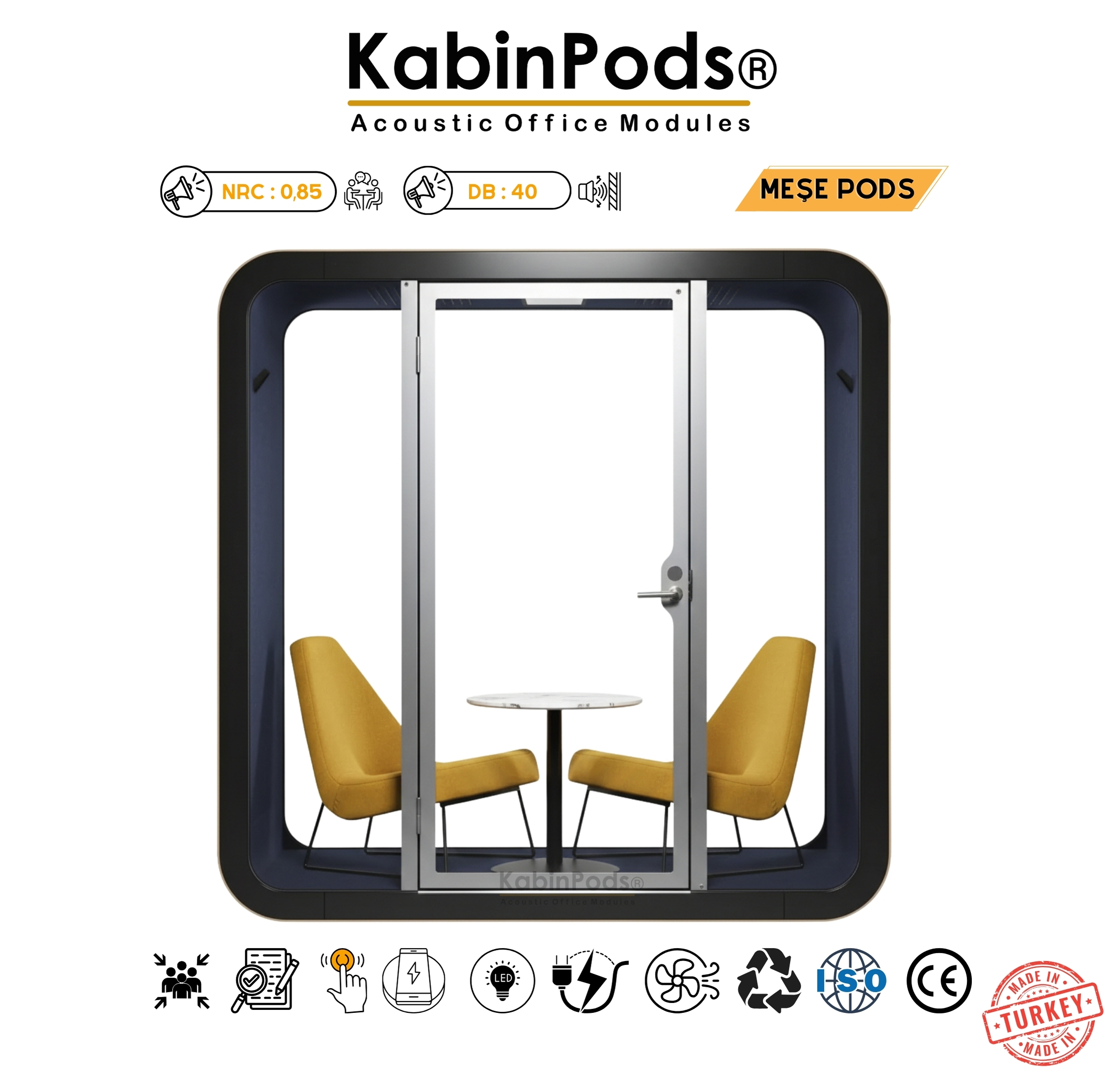
Meeting Pod
KabinPods is a leading manufacturer of meeting pods and silent office cabins.
No middlemen — you buy direct from the factory.
11 years of experience; we have manufactured in our own facilities since 2015.
Every unit is modular, demountable, and relocatable.
5-year corporate warranty on structure and core components.
ISO-certified production with environmentally responsible materials.
Worldwide manufacturing and delivery options.
38–46 dB speech-band insulation with NRC 0.85–0.98 for clear team meetings.
What Is a Meeting Pod?
A meeting pod is a freestanding, sound-controlled workspace built for small-group conversations on open office floors. At KabinPods we manufacture it as a demounted modular unit: factory-built acoustic panels, integrated ventilation and lighting, and on-site assembly in hours — not the weeks required for drywall meeting rooms. When you close the door, outside chatter and foot traffic drop to a level where a team of two to four can discuss strategy, run a video call, or review confidential documents without raising their voices or booking a conference room.
Our meeting pods ship knock-down so they pass through standard doorways and elevators, then lock together on site with a meeting table, seating, and power already specified in the build. When the office moves or the layout changes, the unit disassembles and reinstalls at the new address. That keeps capital from being tied to construction you cannot take with you. In daily use the pod answers a recurring question: where does a small team go right now for a focused conversation without disturbing neighbours or waiting for room availability?
Unlike a phone booth sized for one person, a meeting pod provides interior volume for eye contact, shared screens, and natural conversation dynamics. Unlike a permanent meeting room, it occupies roughly 126 cm in depth and 220 cm in width — a footprint that fits along open-plan edges where full construction would be impossible or uneconomical. We design the pod as infrastructure for collaboration, not a decorative furniture piece that gets ignored after month one.
Occupancy patterns confirm the role: most booked meetings in corporate portfolios involve four or fewer participants, yet traditional floor plans overweight twelve-seat rooms that sit idle between oversized bookings. A meeting pod rightsizes enclosure to actual attendance, which improves schedule throughput and reduces the informal meetings that spill onto open desks because nothing appropriately sized is free.
How Meeting Pods Support Modern Workspaces
Modern workplaces combine open collaboration with frequent need for short, private group sessions. Hybrid teams dial into the same call from one pod; product squads run daily stand-ups without filling a twelve-seat boardroom; HR pairs conduct interviews with clear audio and visual privacy. The pod sits on the floor where work happens — one step off the desk neighbourhood — so utilisation stays high and travel time to distant wings disappears.
We align our meeting pods with activity-based working: open desks for individual focus, pods for two-to-four person exchanges, larger volumes for extended team work. Facilities teams gain predictable acoustic performance without chasing contractors for each layout change. When headcount grows, additional pods scale linearly along a wall rather than triggering a capital project for new drywall rooms.
Meeting pods also support wellbeing on noisy floors. Employees stop negotiating who gets the last conference room slot and stop taking sensitive calls at their desks. The physical boundary signals availability to colleagues while keeping the team inside the conversation loop of the open office — not isolated on another floor.
Real estate teams benefit from measurable density. One linear metre of wall can host a pod serving hundreds of meeting hours per quarter, whereas the same metre of drywall might belong to a single underused room. When lease costs are analysed per productive meeting minute, pods frequently outperform built rooms that were sized for occasional all-hands rather than daily squad cadence.
Key Differences Between Meeting Pods and Meeting Rooms
A traditional meeting room is fixed construction: studs, drywall, MEP rough-in, permits, and weeks of trade coordination. A meeting pod is a product: defined dimensions, published acoustic targets, demounted delivery, and relocation when priorities shift. Meeting rooms suit large presentations and formal board sessions; meeting pods suit the high volume of twenty-to-forty-five minute conversations that dominate modern office calendars.
Acoustic control differs in deployment speed. We engineer pod panels for 38–46 dB speech-band insulation and NRC between 0.85 and 0.98 before the unit leaves the factory. Drywall rooms depend on builder execution, door quality, and HVAC openings that often leak sound. Pods arrive with gaskets, laminated glass, and absorption surfaces tuned as a system.
Cost and flexibility favour pods for small groups. A four-person pod does not consume a twelve-seat room that sits empty between bookings. When the company reconfigures neighbourhoods after a merger, pods move with teams; meeting rooms stay behind as sunk space. For organisations running agile sprints and constant stand-ups, pods are the right granularity — not too large, not single-person restrictive.
Timeline is the hidden difference. Drywall meeting rooms tie up trades, inspections, and furniture procurement across months; a meeting pod arrives demounted, assembles in a working day, and accepts its first booking the same week. For fast-growing companies adding headcount quarterly, that speed prevents collaboration bottlenecks while permanent construction catches up — if it ever does.
Essential Features of a Meeting Pod
A KabinPods meeting pod combines multi-layer acoustic panels, laminated tempered glass, melamine-coated MDF structure, fabric-wrapped interior absorption, ultra-quiet ventilation with minimum 150 m³/h air exchange for four occupants, 18 W LED lighting at 4000 K and 150+ lux, three grounded 220 V outlets plus USB-A, USB-C, data, and wireless charging, a meeting table with four chairs, coat hook, and anti-slip acoustic carpet flooring. The standard four-person footprint measures 126 cm deep by 220 cm wide by 220 cm tall; an alternate depth of 205 cm is available where circulation is tight.
The door uses laminated tempered glass with magnetic lock, perimeter gaskets, and a bottom sliding floor seal — the detail that separates measured insulation from brochure claims. Demounted modular construction needs no floor anchoring on level surfaces. Weight is approximately 350 kg: substantial enough to feel solid, manageable for installation crews without crane access in occupied buildings.
Modularity is a feature, not an afterthought. No floor anchoring is required on level surfaces; assembly completes within a working day on typical sites. Two-person layouts for interview pairs, four-person standard for squad meetings, and larger modular solutions when project teams need more volume are all available from the same panel platform. Colour, glass opacity, and interior finishes are specified at order stage so the pod matches your workplace standards rather than arriving as a generic grey box at the end of a corridor.
Pods · Phone
Phone Booth
When only one person needs privacy for a client call or video line, our phone booth delivers the same acoustic discipline in a compact single-occupant footprint — freeing meeting pods for team sessions.
Explore Phone Booth.webp)
Benefits of Meeting Pods
Adding meeting pods to an open office changes how teams schedule time, protect information, and collaborate without noise spillover. Conference rooms stop filling with four-person syncs that need twenty minutes; desks stay quieter because strategy conversations move into enclosed volumes; and employees gain predictable places for interviews, reviews, and client prep. The return appears in fewer booking conflicts, clearer remote audio, and higher satisfaction on collaboration surveys.
Leadership teams often underestimate how much calendar friction costs in lost minutes: walking to a distant room, waiting for the previous group to leave, reconnecting AV, then walking back. Pods compress that overhead because the right-sized room is beside the work. Over a quarter, hundreds of employees each saving ten minutes per meeting adds up to thousands of hours returned to productive conversation instead of logistics.
Enhanced Privacy for Team Meetings
Team meetings often involve personnel decisions, financial forecasts, client strategy, and unreleased product details. On an open floor those topics travel by default. A meeting pod provides acoustic and visual separation: speech does not transmit as intelligible sentences in the corridor, and the glazed door signals occupancy without requiring a walk to a distant wing. For regulated environments — banking, insurance, legal, healthcare administration — that physical layer supports confidentiality policies alongside digital access controls.
Two-way privacy matters for group dynamics. Participants speak at natural volume inside without whispering, and sudden floor noise does not derail a negotiation or performance review. Our panel stack, door seals, and glass specification are tuned for that balance. Teams report fewer restarts on sensitive discussions and less anxiety about being overheard during compensation conversations or M&A prep.
Visual cues reinforce the boundary: colleagues see that the pod is occupied and defer interruptions, while participants inside relax into candid dialogue instead of monitoring who is walking past. That combination — acoustic control plus social signal — is what makes pods more effective than simply turning chairs toward a corner and hoping for the best.
Improved Collaboration and Communication
Collaboration breaks when groups lack a room or default to a noisy corner. A meeting pod gives two to four people a shared acoustic envelope: eye contact, shared laptop screen, whiteboard notes, and body language read naturally. Video calls with remote colleagues improve because microphones capture direct speech with controlled reverberation — NRC up to 0.98 keeps echo out of Teams and Zoom sessions.
Pods placed near squad neighbourhoods cut calendar friction. Daily stand-ups, sprint planning, design critiques, and sales pipeline reviews happen on rhythm instead of waiting for the one available conference room. Product and engineering teams keep momentum because the pod is ten seconds away, not a booking three hours out.
Facilitators gain predictable conditions: stable lighting for cameras, outlets for shared displays, and a table geometry that supports both laptop-heavy working sessions and conversational retrospectives. Teams stop wasting the first five minutes of every meeting on AV setup and "can you hear me now" checks because the environment was engineered for those tasks before anyone entered.
Noise Reduction in Open Offices
Open-plan background noise commonly sits in the 65–75 dB range — overlapping conversations, phone rings, printer cycles, and HVAC rumble. Inside a KabinPods meeting pod that level drops substantially, typically toward a comfort band where small groups hear each other without competing with the floor. Multi-layer acoustic panels, a dense barrier core, sealed door lines, and interior absorption do the work; the team does not need to shout or repeat points.
Outbound benefit extends to neighbours: conversation inside the pod does not become the soundtrack of the desk row beside it. Facilities teams deploying pods along open edges often see fewer noise complaints and less informal "library rules" enforcement by team leads. The pod contains energy that would otherwise radiate across the floor plan.
Flexible and Space-Saving Design
A 126 × 220 cm footprint fits along corridor edges, at neighbourhood boundaries, and in alcoves too small for traditional meeting rooms. Multiple pods scale linearly without the circulation problems a bank of permanent construction would create. Because units are freestanding and demounted, you reposition them after a pilot period if utilisation data shows a better location — closer to sales, nearer to HR, or adjacent to the innovation lab.
Height at 220 cm provides comfortable headroom for standing stretch and tall users while fitting standard ceiling grids. Weight around 350 kg per unit is stable without floor anchors yet movable with planned disassembly when the office relocates. That combination — compact footprint, no wet trades, relocatable — is why retrofit projects in occupied towers choose pods over build-out.
Space planners often pair pods with phone booths on the same wall: single-person calls stay out of four-seat modules, preserving pod availability for meetings that genuinely need a table and multiple chairs. That pairing maximises throughput per linear metre of acoustic infrastructure.
Meeting Pod Configurations
We produce meeting pods in configurations matched to how your floor actually meets — not a single catalogue size forced into every scenario. Two-person pods suit interview pairs and executive check-ins; four-person standard covers most squad rhythms; larger modular volumes support extended workshops and six-to-eight person sessions when space allows.
Configuration choice should follow observed meeting size, not aspirational headcount. Facilities teams that audit calendar data often discover eighty percent of internal bookings involve four or fewer people — pods aligned to that reality free oversized rooms for the minority of sessions that genuinely need them.
Two-Person Meeting Pods
Two-person meeting pods serve recruiter-candidate interviews, manager-one-on-ones, client prep between account lead and specialist, and paired design reviews. Interior layout prioritises facing seating or side-by-side laptop work with a compact table. Acoustic targets match the four-person line — insulation in the 38–46 dB band and NRC between 0.85 and 0.98 — because privacy requirements do not shrink when occupancy drops.
Footprint reduces versus the four-seat module where site plans demand it, while ventilation, lighting, and power remain sized for sessions up to sixty minutes. HR teams and executive floors often specify two-person pods in banks along a quiet edge so back-to-back interviews do not queue on a single room calendar.
Pair configurations also suit legal privilege conversations, medical administration triage with a supervisor, and mentorship sessions where a junior and senior colleague need eye contact without an audience of fifty desks. The smaller envelope costs less floor area while preserving the acoustic discipline of the four-seat line.
Four-Person Meeting Pods
Our standard four-person meeting pod is the workhorse configuration: 126 cm depth, 220 cm width, 220 cm height, meeting table, four chairs, coat hook, and full power package. It covers daily stand-ups, sprint retrospectives, small client presentations, finance review huddles, and video calls with distributed team members. Air exchange targets minimum 150 m³/h so four occupants breathe comfortably through forty-five minute sessions.
Three 220 V outlets, two USB-A ports, one USB-C port, data connection, and wireless charging support laptops, displays, and phones simultaneously without extension cords across the doorway. This is the configuration we recommend when a neighbourhood of fifteen to twenty-five people needs reliable small-group infrastructure.
Facilities teams appreciate that standard equipment — table, chairs, hook — ships with the module, avoiding a second procurement track for loose furniture that might not fit the interior width. Colour and finish selections are locked at order so what arrives on site matches the approved render, not a last-minute substitute from warehouse stock.
Large Meeting Pods for Teams
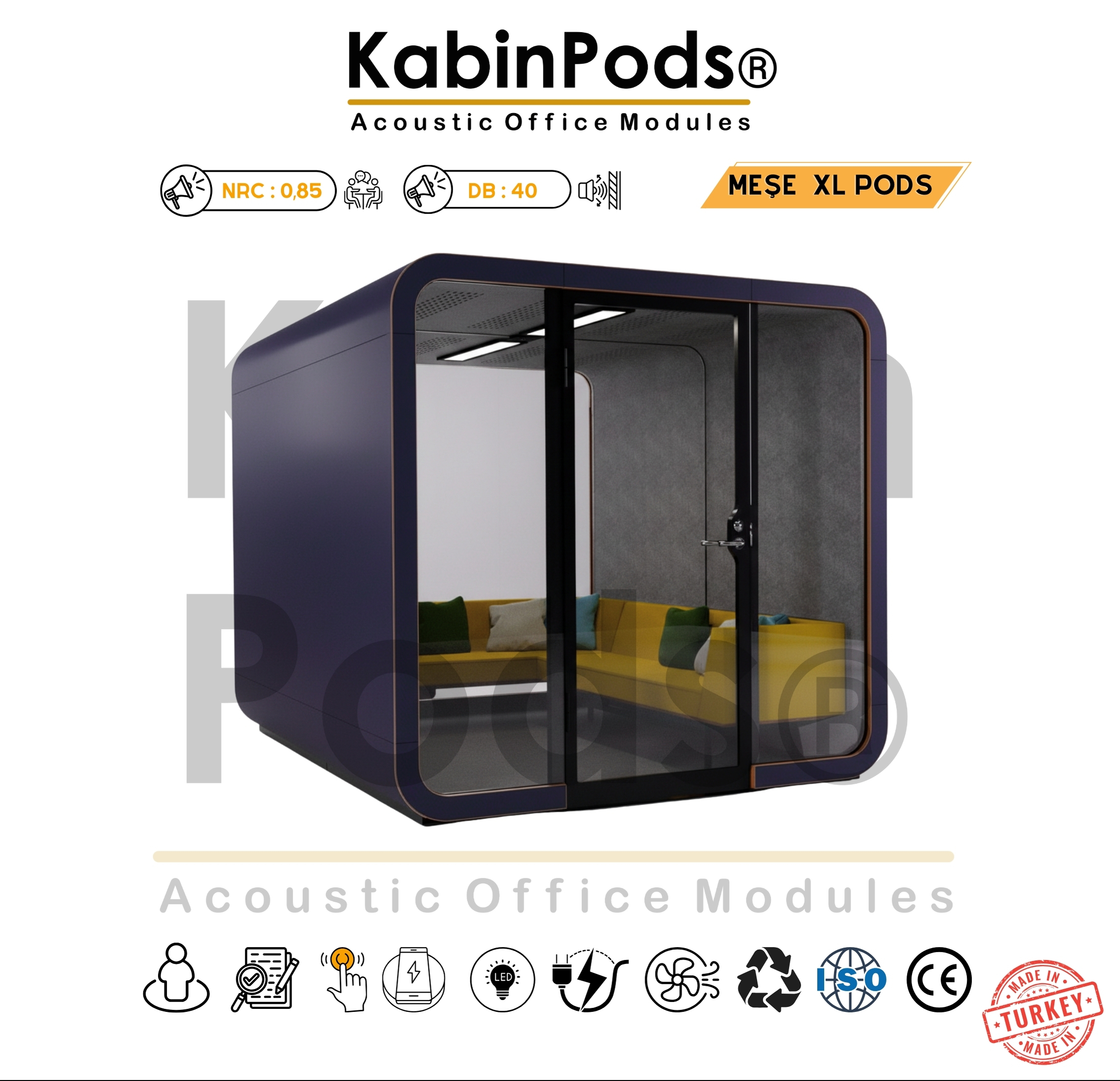
When squads grow beyond four or workshops need wall space for facilitation, larger meeting pods extend interior volume while keeping modular assembly and demounted delivery. These units accommodate six to eight participants for training bursts, vendor demos, and cross-functional alignment without reserving the main boardroom.
Ventilation capacity, lighting lux levels, and table geometry scale with occupancy so the room does not become stuffy or dim at capacity. For teams that regularly outgrow four seats, we also point to our work pod line for extended focus and larger team volumes — complementary, not competing, in the same floor plan.
Modular Meeting Pod Solutions
Modular meeting pod solutions link multiple panel modules or adjacent units for organisations that need flexible capacity — quarterly all-hands prep in a larger volume, standard four-seat day-to-day. Demounted construction means expansion does not require demolition; modules add when headcount grows and reconfigure when departments merge.
We document module interfaces, cable paths, and door orientations on drawings before production so facilities teams plan floor possession and circulation once. Modular thinking also supports multi-site rollouts: the same specification replicates across regional offices without re-engineering per city.
Pods · Work
Work Pod
When meetings stretch into half-day workshops or teams need desk-grade ergonomics inside an acoustic envelope, our work pod scales volume and furnishing for longer collaborative sessions.
Explore Work Pod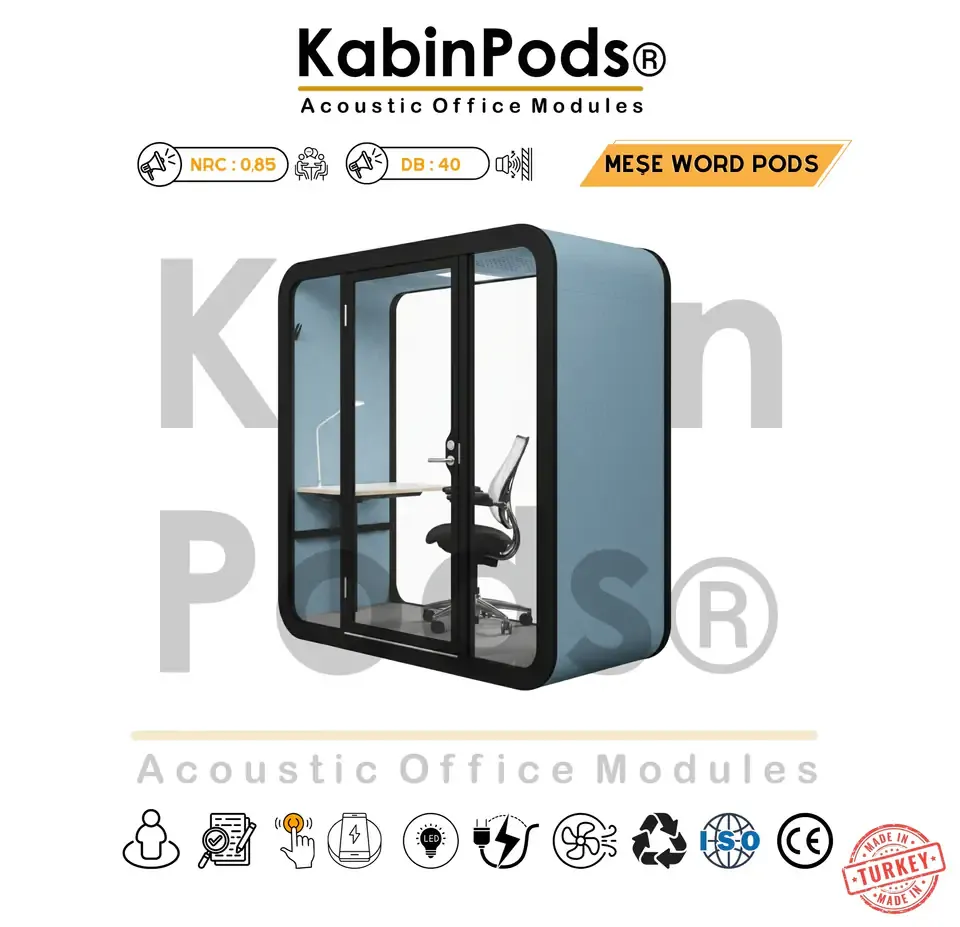
Technical Features
Every technical feature on our meeting pod serves conversation quality, occupant comfort, or deployment speed. We do not treat ventilation, absorption, or outlets as optional extras on a stripped base model — they are part of the working specification because a pod that is quiet but stuffy, dim, or outlet-starved gets abandoned after one bad meeting.
Acoustic Insulation Performance
The body uses multi-layer acoustic panels: melamine-coated MDF structure, a dense barrier layer, and fabric-wrapped interior faces. We target 38–46 dB attenuation in speech frequencies; field performance depends on site conditions and adjacent noise sources but consistently delivers controlled transmission for small-group conversation. NRC between 0.85 and 0.98 limits reverberation so speech stays intelligible for in-person participants and remote attendees on the same call.
The door carries laminated tempered glass — impact-resistant, with an interlayer that dampens vibration through the glazed area. Magnetic lock, perimeter gaskets, and bottom sliding floor seal close the usual leak paths. Anti-slip acoustic carpet on the floor absorbs footfall impact that would otherwise flutter through the panel system when occupants shift chairs or stand to present.
Ventilation and Climate Control
We use ultra-quiet fans rated around 16 dB so air movement does not replace office noise with a new hum inside the pod. For the four-person configuration we engineer minimum 150 m³/h air exchange during occupied sessions — critical when meetings run thirty to sixty minutes with a closed door. Grilles are positioned for even flow without drafting directly onto faces or microphones.
Maintenance is straightforward: periodic grille cleaning keeps airflow at design rate. Facilities teams verify fans during quarterly checks the same way they inspect life-safety paths — predictable airflow prevents users from propping the door open, which would collapse insulation performance and leak conversation to the floor.
In warm climates or high-occupancy schedules, ventilation performance separates usable pods from showcase units that teams abandon by mid-afternoon. We size airflow for worst-case closed-door occupancy, not an empty box with the door ajar — that is the engineering difference between a meeting pod spec sheet and a meeting pod people actually book twice a day.
Integrated LED Lighting
Integrated 18 W LED lighting at 4000 K daylight colour temperature illuminates the interior at 150+ lux — bright enough for note-taking, document review, and screen work without the yellow cast that tires eyes on long sessions. Even distribution matters for video calls: faces read clearly on camera without harsh shadows from a single overhead point.
We place luminaires to avoid glare on laptop screens while keeping participants well lit for remote colleagues. Sensor control can reduce energy draw when the pod is empty — useful when a bank of units sits on a large floor with intermittent booking patterns.
Power, USB, and Network Connectivity
Each four-person pod includes three grounded 220 V AC outlets, two USB-A ports, one USB-C port, a data outlet for laptop connectivity, and wireless charging for phones. Cable routing uses concealed channels so the interior stays uncluttered and trip hazards are eliminated around the table. Running two laptops, a display adapter, and phones simultaneously should not require an extension cord dragged through the doorway.
Outlet placement follows meeting ergonomics: reachable from seated positions, clear of door swing, and compatible with plug types specified at order for international deployments. Network connectivity supports wired stability for video calls where Wi-Fi congestion on the open floor would otherwise drop packets mid-presentation.
Premium Interior Finishes
Interior surfaces use acoustic fabric on high-NRC panels — warm to the touch, not cold hardboard against elbows during a long workshop. Anti-slip acoustic carpet underfoot reduces chair roll noise and provides comfortable contact for sessions that mix seated and standing facilitation. Meeting table and four chairs are standard equipment, sized for laptop depth and natural conversation distance.
Coat hook placement keeps outerwear off chair backs and away from door swing. Finishes are selected for daily cleaning cycles in corporate and coworking environments — replaceable carpet tiles and wipeable surfaces where facilities protocols demand it.
Table edges are radiused where users pass in tight layouts, and chair glides are chosen to minimise scrape noise that would otherwise transmit through the floor plate. Small details — felt pads, cable grommets, consistent fabric orientation — signal that the pod is a finished room, not a particle-board box rushed to site.
Where Are Meeting Pods Used?
Meeting pods deploy anywhere open work meets small-group conversation. The pattern repeats across sectors: identify high meeting intensity, place pods within ten seconds of those neighbourhoods, measure utilisation, add units when queues form at the door. Below are the environments where we see the strongest fit.
Corporate Offices
Corporate open floors — technology, consulting, media, financial services, shared services — generate constant small-group traffic. Product squads, regional sales pods, HR business partners, and marketing campaign teams all need recurring privacy without leaving the building. We place meeting pods near team neighbourhoods so adoption stays high; a pod hidden on another floor rarely earns its footprint.
Retrofit projects in occupied towers benefit from demounted delivery: no wet trades, minimal downtime, assembly during off-peak hours. When the company reconfigures after a merger or headcount shift, pods move with the teams instead of staying behind as misaligned fixed rooms.
Department leads in finance, product, and commercial functions often share a pod bank rather than each fighting for the same corner conference suite. Booking friction drops because capacity is distributed at the neighbourhood level — the pod beside your desk is yours in practice even when the central room calendar shows red all afternoon.
Coworking Spaces
Coworking operators offer meeting pods as bookable amenities that differentiate the space from hot-desk-only competitors. Members run client workshops and team syncs without apologising to strangers at the next table; operators monetise premium meeting access on hourly or credit plans. Multiple four-person pods scale better than one large conference room for a membership base with overlapping schedules.
Hybrid members who visit two or three days per week still need professional meeting infrastructure on those days — a meeting pod answers that without assigning permanent enclosed offices to every pass holder.
Educational Facilities
Universities and training centres use meeting pods for admissions committee huddles, student advising triads, career-services interview pairs, and faculty collaboration in open administrative areas. Library-adjacent floors and student success centres gain controlled volumes without constructing permanent interview suites during short funding windows.
Staff conducting scholarship reviews, accreditation prep, and sensitive student conversations benefit from acoustic privacy in busy campus buildings where office walls are often lightweight partitions. Modular pods install during term breaks and relocate if departments move — a flexibility permanent build rarely offers.
Public and Commercial Buildings
Public-facing commercial buildings — innovation hubs, municipal service centres, airport business lounges, and mixed-use atrium offices — need small meeting infrastructure that does not require tenant construction permits for every layout change. Meeting pods deliver enclosed conversation volumes in shared amenity zones where drywall is impractical or prohibited by landlord agreements.
Visitor centres and showrooms use pods for confidential sales configuration sessions while the broader space remains open to foot traffic. Property managers value demounted units that vacate with the tenant instead of leaving orphaned rooms that do not match the next occupant's plan.
Lobby and atrium placements demand finishes that survive public traffic: scratch-resistant exteriors, cleanable glass, and lighting that reads professional on evening tours. We specify those surfaces deliberately because a pod in a reception sightline represents the tenant's brand whether facilities intended it or not.
Pods · Acoustic
Acoustic Booth
Our acoustic booth family spans single-person call volumes through team meeting sizes with the same modular assembly and published acoustic targets — choose the tier that matches your floor plan.
Explore Acoustic BoothCustom Meeting Pod Solutions
Standard specifications cover most deployments; custom options align the pod with your interior design standards, brand identity, and usage detail. We produce each unit to order rather than shipping anonymous stock grey boxes that clash with reception-grade architecture.
Size and Layout Options
Depth options include 126 cm and 205 cm modules where circulation plans demand a slimmer profile against a corridor. Two-person and four-person layouts adjust table geometry and chair count; larger modular configurations extend width and interior volume for six-to-eight participants. We confirm door swing, chair pull-back clearance, and ADA-adjacent circulation on drawings before production so installation day does not surface surprises.
Interior layout can bias toward facing interview pairs, rectangular squad tables, or presentation orientation with one short wall for display mounting on project basis. Power and data outlets follow the layout so laptops face the screen direction users actually adopt.
Glass and Door Configurations
Laminated tempered glass is standard on the door leaf; opacity, tint, and banding levels adjust privacy versus openness. Full-height clear glass maximises borrowed light from the open floor; frosted or acoustic film bands reduce visual exposure for sensitive sectors. Hinge orientation and door swing direction are confirmed against site plans so corridors stay clear and chair egress meets local code expectations.
Glass acoustic performance is matched to the panel system — swapping to a thinner non-laminated leaf would compromise the insulation target, so we keep laminated build across configurations. Bottom sliding floor seals remain standard because that detail governs real-world speech privacy more than incremental glass area.
Interior and Exterior Color Choices
Interior fabric colours span neutral greys, warm beiges, corporate blues, and accent tones matched from your palette. PET felt and acoustic fabric panels wrap wall surfaces for absorption and appearance; melamine-coated MDF appears on structural faces where durability matters. Samples are available during specification so design teams approve texture and colour under your actual floor lighting — not showroom LEDs that lie about hue.
Exterior faces combine melamine-coated MDF and aluminium profile framing. We manufacture in any colour your project requires — brand greens for a headquarters lobby, white for clinical admin areas, dark anthracite for studio-style offices. Two-tone schemes — darker exterior, lighter interior — are common when pods sit in glass-heavy architecture and need to read as furniture, not temporary equipment.
Branding and Custom Design
Branding options include custom signage panels, vinyl graphics on exterior faces, and coordinated trim colours for multi-site rollouts that must match visual identity guidelines. We document branded elements on production drawings for approval before manufacture so marketing and facilities align on the same reference.
Custom design requests — integrated display mounts, additional whiteboard surfaces, upgraded seating, or accessibility adaptations — are quoted on project basis with lead times stated upfront. The goal is a pod that looks intentional in your space and supports how your teams actually meet, not a catalogue box with a logo sticker added late.
Multi-site enterprises often standardise one branded pod specification for global recognition while allowing regional colour accents. We maintain bill-of-materials traceability so a replacement panel in London matches the fabric lot deployed in Istanbul — continuity matters when facilities teams manage dozens of units across a portfolio.
Why Choose KabinPods Meeting Pods?
KabinPods builds meeting pods as acoustic products first, furniture second. We publish insulation and absorption targets, stand behind a five-year warranty, and deliver internationally with the same panel system used across our pod family — phone, meeting, work, office cabin, and acoustic booth lines share production discipline so performance is consistent site to site.
High Acoustic Performance
We engineer for measured results: 38–46 dB speech-band insulation, NRC between 0.85 and 0.98, and two-way speech privacy suited to open offices. Certificates include ISO 140-3 acoustic measurement, ISO 717-1 sound insulation, ISO 10534-2:2023 conformity, and ISO 11957 — not marketing adjectives without test backing. Field teams verify door seals and gasket continuity during installation because acoustic performance lives in details, not brochure numbers alone.
If your floor runs especially hot in noise — call-centre density, trading-floor adjacency, atrium echo — we advise on placement and quantity so pods deliver usable conditions, not theoretical lab scores in a hostile acoustic environment.
We publish targets so procurement can compare vendors on numbers, not adjectives. When a competitor quotes a single dB figure without frequency band or test method, ask how their door seal performs after six months of daily use — that is where cheap pods fail and where our gasket and glass specification is designed to hold.
Modern and Functional Design
Clean lines, framed glass, fabric interiors, and integrated ventilation position the pod as workplace furniture aligned with contemporary office aesthetics. Custom colours integrate with brand environments from startup lofts to law-firm receptions. Meeting table and seating proportions avoid the cramped telecom-cabinet feel that makes teams resist enclosed collaboration.
Lighting and ventilation are integrated flush — no dangling consumer fans or clip lamps — so the pod reads as professional infrastructure clients and candidates see on office tours. Functional layout supports laptops, hybrid calls, and document spread without users juggling gear on their knees.
Durable Manufacturing Quality
Melamine-coated MDF structure, aluminium framing, laminated tempered glass, and replaceable wear parts are chosen for ten-year office life, not two-year fit-out cycles. Hinges, locks, and fan units are serviceable; carpet tiles lift for cleaning or replacement. Five-year warranty with spare parts support means facilities teams are not hunting proprietary components after year three when utilisation has proven the investment.
At roughly 350 kg per four-person unit the pod is stable without floor anchors on level surfaces yet substantial enough to feel solid when the door closes — no lightweight partition wobble that undermines user confidence during important client conversations.
Hardware cycles are documented: which hinge, which fan filter, which gasket profile belongs to which production batch. When a site expands three years after initial deployment, replacement parts match the installed population instead of forcing a visual and acoustic patchwork along the wall.
Worldwide Delivery and Installation
We ship demounted modules internationally and coordinate on-site assembly with local crews or our network partners. Standard installation in our primary service regions is included in list pricing; overseas projects receive written quotes for freight, customs handling, and assembly labour based on site access and schedule. Lead times and drawings are issued before production so your project team plans floor possession dates accurately.
When you expand from one site to many — rollout across regional offices — the same meeting pod specification replicates without re-engineering. Training materials for facilities cover filter cleaning, seal inspection, and relocation steps so your team owns lifecycle management after handover. That is how we support global organisations that need one acoustic standard, not a different mystery box in every country.
Installation crews receive packing lists keyed to module sequence so panels assemble in the order the drawings specify — reducing on-site improvisation that delays handover. We stay through first successful bookings when project scope requires it, verifying that ventilation, lighting, and door closure meet the performance you purchased before facilities sign acceptance.
Watch KabinPods products in action

CUSTOMER REVIEWS
What Customers Say About Meeting Pod
MEETING POD FAQ
Frequently Asked Questions About Meeting Pods
Answers to the questions facilities teams ask when adding meeting pods to open-plan offices.
A meeting pod is a sound-insulated office cabin for 2–4 person team meetings, video conferences, and confidential discussions on open floors. Use it for sprint syncs, client calls, HR interviews, and internal presentations when a fixed meeting room is unavailable or too costly to build.
You May Also Like
Proudly Manufactured in Turkey
Every KabinPods unit is built in our own factory to high quality standards. We ship worldwide without compromising on materials or workmanship.
11 Years of Experience
Our specialist team has supported corporate clients for more than eleven years with reliable delivery and professional project support at every stage.
Fast, Secure Shipping
Flexible delivery options and dependable logistics get your acoustic booths to site on schedule — across Europe, the Middle East, and international projects.